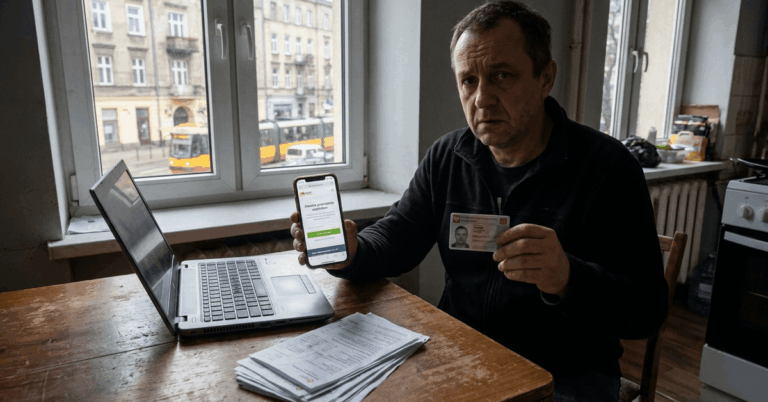
The spread on a cash loan in Poland right now is wild. As of August 2026, RRSO (the annual percentage rate that includes all costs) ranges from 8.46% to 21.35% across 11 active bank offers on Totalmoney.pl. That gap means two borrowers taking the same 20,000 zł could pay thousands of złoty apart in total cost.
And the banks making it look cheap are often the ones burying costs elsewhere. A “0% prowizja” headline does not mean a free loan. It usually means a higher margin baked into every single monthly payment for years.



This article is for the person about to open five browser tabs, compare rates, and apply to three banks this weekend. That instinct could cost more than the loan itself. Stick around, and I’ll explain why.
Why RRSO Gaps Between Polish Banks Are So Wide
Comparing cash loans in Poland without understanding RRSO is like comparing apartments by rent alone and ignoring utility costs.
Two banks might advertise oprocentowanie (interest rate) at 7.8%, but one tacks on a prowizja (commission fee) of 5% and the other charges zero.

The RRSO, legally required since the Ustawa o kredycie konsumenckim (Consumer Credit Act), wraps everything into a single percentage.
Fixed vs. Variable Rates in 2026
Pekao S.A. offers some of the lowest RRSO figures in August 2026: around 8.07% to 8.1% for new customers on variable-rate products tied to WIBOR. VeloBank sits in a similar range.
Poland is expected to transition from WIBOR to a new benchmark called POLSTR (Polish Short Term Rate), and nobody knows exactly how that shift will shake out on existing loan contracts.
Fixed-rate cash loans run higher. Santander Consumer Bank’s representative example for 20,000 zł over 60 months comes in at RRSO 8.55%, fixed.
I’d argue that the small premium for a fixed rate is worth it on any loan longer than 36 months, because a 0.5% RRSO difference means little compared to the risk of POLSTR spiking after the WIBOR transition.
The 0% Prowizja Trap
Banks like BNP Paribas and Alior Bank run promotions with zero commission. The math looks clean: 20,000 zł at BNP Paribas on 48 months, 8.49% oprocentowanie, RRSO 8.83%, rata around 493 zł.
Compare that to an offer with 2% prowizja but a lower interest rate, and the total repayment might end up within 100 zł of each other.
The 0% prowizja deal locks you into their rate structure. A bank charging a 1-2% upfront fee often offers room to negotiate the margin down, especially for existing customers.
How BIK Inquiries Punish You for Comparison Shopping
This is the part that catches Polish borrowers off guard. BIK (Biuro Informacji Kredytowej) is Poland’s credit bureau. Every time a bank runs a hard credit check on your application, it shows up in the BIK system.
Multiple hard inquiries within a short period signal financial desperation to lenders, not smart shopping.
The 14-Day Window That Barely Helps
Polish BIK does group same-type inquiries made within 14 days as a single inquiry. But that window is narrow and only applies to the same product type. Apply for a cash loan at PKO BP on Monday and then at ING on Friday of the following week, and those count as two separate hard pulls.
I think most people would save more money by downloading their own BIK report for 39 zł, studying the score, and then applying to exactly one or two banks that match their profile.
The conventional advice to “compare as many offers as possible” ignores this mechanic entirely. Three rejected applications in one month can drop a BIK score enough to push the fourth bank’s offer into a worse pricing tier.
No Credit History is Almost as Bad as Bad History
A BIK score of “no-score” sounds neutral. Banks treat it as high risk. Newcomers to Poland or young adults without any credit history face automatic rejections or sharply higher RRSO.
The fix takes time: a small installment purchase (300-500 zł at Media Markt on raty) or a low-limit credit card paid off monthly can build a BIK profile over about 6 months of on-time payments.
What the April 2026 CJEU Ruling Changed for Polish Borrowers
On 23 April 2026, the Court of Justice of the European Union issued a ruling in case C-744/24 (Bank Polska Kasa Opieki) that directly affects how Polish banks structure cash loans.
The court said banks can finance credit costs (like rolling a commission into the loan amount) but cannot charge interest on that financed portion because the money was never paid out to the borrower.
This ruling reshapes the sankcja kredytu darmowego (SKD), Poland’s “free credit sanction.” Borrowers whose banks violated this principle may be entitled to refunds of overpaid interest.
For anyone taking out a new kredyt gotówkowy in 2026, it means checking whether the bank’s representative example charges interest on financed costs. If it does, that contract may already be on shaky legal ground.
Fees Beyond the Interest Rate
A kredyt gotówkowy carries costs that sit outside the interest rate itself. Breaking these down loan by loan is the only way to compare accurately.
Common fees on Polish cash loans include:
- Prowizja (origination fee): one-time, typically 0-5% of the loan amount, sometimes waived in promotions
- Opłata administracyjna: periodic management fees that some lenders charge monthly or annually
- Ubezpieczenie (insurance): often bundled into the loan as “optional” but priced as though mandatory, with premiums far above what an independent insurer would charge
- Early repayment fee: capped by Polish law at the interest that would have accrued on the remaining term, but still present
One cost that flies under the radar is cross-sold insurance. Banks like to package life insurance or unemployment insurance into the loan offer.
The premium gets rolled into the monthly rata, making it invisible unless the borrower reads every line of the umowa (contract).
An independent life insurance policy from PZU or another insurer can cost 40-60% less than the bank’s bundled option for identical coverage.
Who Should and Shouldn’t Take a Kredyt Gotówkowy
Not every financial need calls for a cash loan. Knowing when a different product fits better can save thousands.
A kredyt gotówkowy may suit borrowers who:
- Need 5,000 to 60,000 zł for a defined purpose (renovation, medical expense, car purchase)
- Have at least 6 months of BIK history and stable employment
- Can handle a fixed monthly rata for 24 to 60 months without stretching their budget past 40% of take-home pay
| Feature | Kredyt Gotówkowy (Bank) | Pożyczka Online (Non-Bank) | Linia Kredytowa (Credit Line) |
|---|---|---|---|
| Typical RRSO (2026) | 8-13% | 16-29%+ | 10-15% |
| Max Term | Up to 120 months | Usually 12-48 months | Revolving |
| Prowizja | 0-5% | Often 5-15% | Annual fee |
| BIK Required | Yes | Sometimes | Yes |
Non-bank lenders like Smartney or SuperGrosz charge RRSO as high as 16.72% or more. A revolving credit line from a bank can be cheaper for short-term, repeated needs.
I’d recommend a credit line over a cash loan for anyone who borrows under 5,000 zł and plans to repay within 6 months, because the interest calculation on revolving credit rewards fast payoff in a way that a fixed-term loan does not.
The Application Checklist That Saves Time
Applying for a kredyt gotówkowy online in 2026 is straightforward at most Polish banks. The process rarely requires a branch visit.
Documents and details to have ready:
- PESEL number and valid ID (dowód osobisty)
- Proof of income: payslips from the last 3 months, or PIT-37 for self-employed applicants
- Address and employment details, including employer’s NIP number
- An existing bank account (some banks require you to open one with them)
One mistake to avoid: applying at a bank where you already hold a closed loan from the past 6 months.
VeloBank and Pekao both restrict their promotional RRSO rates to customers who have not held a cash loan or consolidation loan with them in the last 6 months. Existing customers get bumped to a higher pricing tier.
Questions People Ask About Cash Loans in Poland
These are the searches that keep popping up, with answers that add something beyond the basics.
- Q: Can I get a kredyt gotówkowy in Poland as a foreigner?
Yes, but banks require a PESEL, proof of income from a Polish employer, and at least 6 months of positive BIK history. Some banks are more open to EU nationals than non-EU applicants. Expect a smaller approved amount and possibly a higher RRSO compared to Polish citizens with established credit profiles. - Q: How long does it take to get approved for a cash loan in Poland?
Online applications at major banks like ING, PKO BP, or mBank can return a decision within 24 hours. Disbursement usually takes 1-3 business days after signing the umowa. Non-bank lenders are faster but charge significantly more in total cost. - Q: Does paying off a kredyt gotówkowy early save money?
Polish law guarantees the right to early repayment, and the bank must reduce the total cost proportionally. The early repayment fee is capped at the interest remaining on the contract. On a 48-month loan paid off at month 24, the savings on interest alone can reach several hundred złoty depending on the original RRSO.
Conclusion
The RRSO spread across Polish banks in 2026 means lazy comparison costs real money on every monthly rata. Download a BIK report before applying to any bank, not after the first rejection.
The April 2026 CJEU ruling gave borrowers a new tool to challenge inflated interest on financed costs. A single well-researched application beats five rushed ones every time.